India’s Nuclear Milestone: Kalpakkam PFBR Achieves Criticality | KhabarForYou
- Khabar Editor
- 07 Apr, 2026
- 96630

Email:-infokhabarforyou@gmail.com
Instagram:-@khabar_for_you


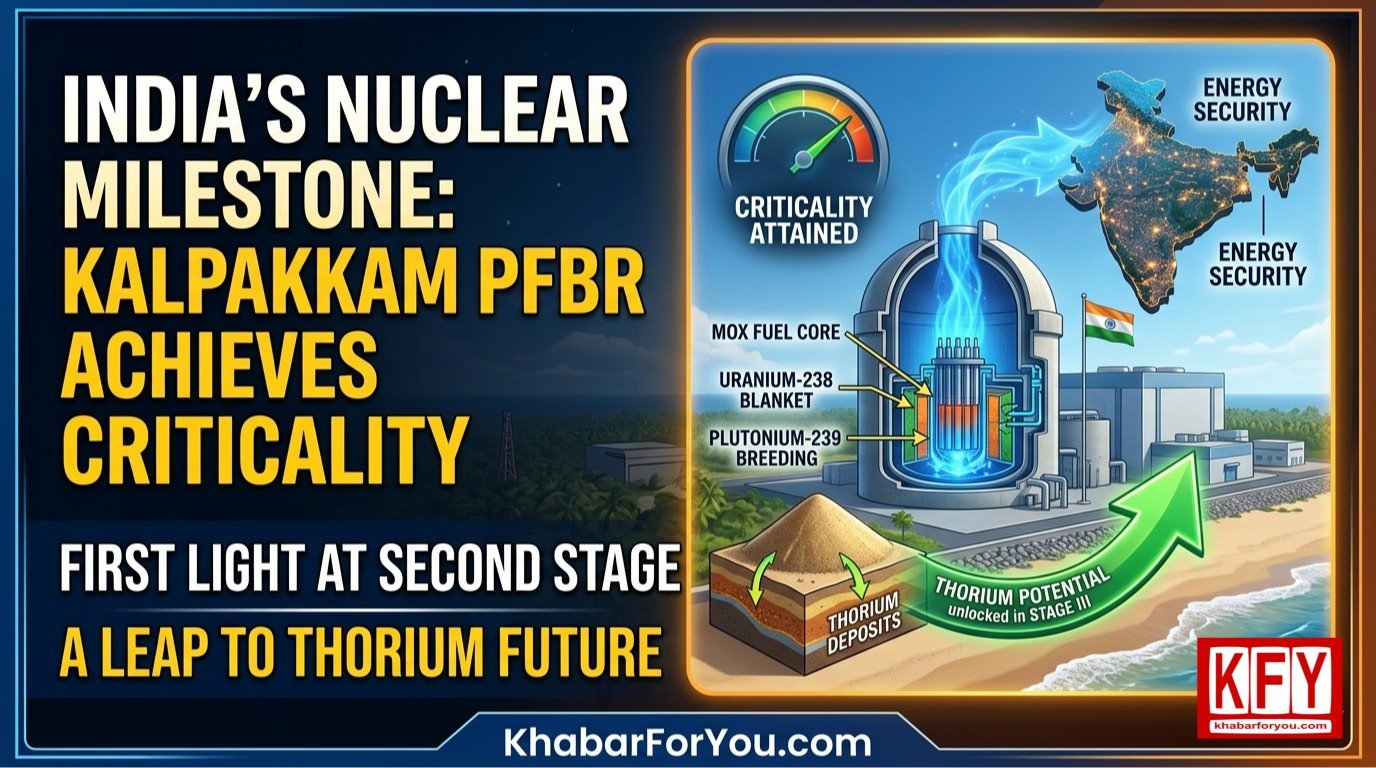
In the quiet coastal town of Kalpakkam, roughly 70 kilometers from Chennai, a low hum of machinery and a surge of scientific euphoria marked a historic turning point for India’s energy future. On the evening of April 6, 2026, the 500-MWe Prototype Fast Breeder Reactor (PFBR) officially attained "criticality" - the state where a nuclear chain reaction becomes self-sustaining.
Prime Minister Narendra Modi, hailing the achievement as a "defining step," noted that India has now entered an elite club of nations capable of commercializing fast-breeder technology. But beyond the political rhetoric lies a complex, decades-long investigative journey of scientific tenacity, massive cost overruns, and a radical vision to turn India’s vast beach sands into an inexhaustible power source.
Read More - India Toll Cash Ban: NHAI Mandates FASTag & UPI from April 10 | Khabar For You
The ‘Alchemy’ of the Second Stage
The PFBR is not just another power plant; it is a "breeder." Unlike conventional Pressurized Heavy Water Reactors (PHWRs) that consume fuel, the PFBR produces more fissile material than it burns. By using a core of Mixed Oxide (MOX) fuel surrounded by a "blanket" of Uranium-238, the reactor transmutes fertile material into Plutonium-239.
“This is nuclear alchemy,” says a senior scientist at the Indira Gandhi Centre for Atomic Research (IGCAR), speaking on condition of anonymity. “We are effectively creating our own fuel for the future. Without this second stage, India’s nuclear dreams would be capped by our limited domestic uranium reserves. With it, we unlock the door to the third stage: Thorium.”
An Investigative Look: The Long Road to 2026
The road to yesterday’s success was paved with significant hurdles. Initially sanctioned in 2003 with a target completion date of 2011, the project, managed by Bharatiya Nabhikiya Vidyut Nigam Limited (BHAVINI), faced nearly 15 years of delays.
Our investigation into the project’s timeline reveals three primary bottlenecks:
1.Sodium Engineering: Unlike standard reactors that use water, the PFBR uses liquid sodium as a coolant. Sodium is notoriously temperamental - it reacts violently with air and water. Perfecting the "leak-proof" plumbing for 1,750 tonnes of molten sodium took years of iterative testing.
2.Indigenous Manufacturing: Due to historical international sanctions, almost every component - from the massive reactor vessel to the specialized pumps - had to be designed and fabricated within India.
3.Regulatory Scrutiny: The Atomic Energy Regulatory Board (AERB) enforced unprecedented safety protocols, particularly after the Fukushima disaster, requiring total redesigns of the passive cooling systems.
The Thorium Connection: Why This Matters Globally
India holds roughly 25% of the world’s thorium reserves, largely concentrated in the monazite sands of Kerala and Tamil Nadu. However, thorium itself cannot be used directly as fuel. It must first be "cooked" in a fast-breeder reactor to become Uranium-233.
The criticality of the PFBR is the functional bridge to this "Stage III" goal. Once a fleet of breeders is operational, India can transition to a thorium-based fuel cycle, potentially providing energy security for over 250 years without importing a single gram of uranium.
Safety Concerns and Environmental Impact
Critics and environmentalists have long raised concerns about the Kalpakkam site, citing its proximity to the coast and the risks of sodium fires. However, BHAVINI officials maintain that the PFBR is a "third-generation" reactor with inherent safety features.
"The reactor is designed to shut down naturally even if the power fails," explains Dr. R. Srinivasan, a nuclear safety consultant. "It has a 'negative power coefficient,' meaning if the temperature rises beyond a point, the physics of the core naturally slows the reaction down."
Economic Implications: The 100 GW Ambition
The achievement comes on the heels of the SHANTI Act (2025), which opened India’s nuclear sector to private and foreign investment. The government has set an audacious target of 100 GW of nuclear capacity by 2047.
While the PFBR cost approximately ₹15,000 crore (nearly double the original estimate), economists argue the long-term "fuel breeding" makes it cost-competitive. “The capital cost is high, but the fuel cost over 60 years is negligible because you are generating your own,” says energy analyst Megha Gupta.
What Happens Next?
Reaching criticality is the "first ignition." Over the next several months, the reactor will undergo a series of low-power tests to validate physics parameters. According to sources at BHAVINI, the reactor is expected to be synchronized with the regional grid by September 2026, gradually ramping up to its full 500 MW capacity by the end of the year.
As the sun set over the Bay of Bengal yesterday, the lights at the Kalpakkam facility stayed on - a symbolic precursor to a future where India’s energy is harvested from its own shores. For the scientists who spent their entire careers on this project, the "critical" click of the control rods was more than just a technical milestone; it was the realization of a sovereign dream.
Key Facts: PFBR Kalpakkam
Type: Sodium-cooled Fast Breeder Reactor (FBR)
Capacity: 500 MWe
Location: Kalpakkam, Tamil Nadu
Agency: BHAVINI (Construction/Ops), IGCAR (Design)
Fuel: Mixed Oxide (MOX) - Plutonium & Uranium
Significance: Only the second country after Russia to have a commercial-scale FBR.
Business, Sports, Lifestyle ,Politics ,Entertainment ,Technology ,National ,World ,Travel ,Editorial and Article में सबसे बड़ी समाचार कहानियों के शीर्ष पर बने रहने के लिए, हमारे subscriber-to-our-newsletter khabarforyou.com पर बॉटम लाइन पर साइन अप करें। |
| यदि आपके या आपके किसी जानने वाले के पास प्रकाशित करने के लिए कोई समाचार है, तो इस हेल्पलाइन पर कॉल करें या व्हाट्सअप करें: 8502024040 |
#KFY #KFYNEWS #KHABARFORYOU #WORLDNEWS
नवीनतम PODCAST सुनें, केवल The FM Yours पर
Click for more trending Khabar
Leave a Reply
Your email address will not be published. Required fields are marked *
Search
Category